




This article is written by HUATENG (a manufacturer specializing in raised access floor solutions with over 20 years of experience). Whether planning a data center, office renovation, or commercial space upgrade, understanding floor pedestal types is crucial for project success. These structural components form the foundation of raised access flooring systems, providing the critical space needed for cable management, airflow distribution, and building services integration. The right pedestal choice directly impacts system stability, load capacity, and long-term performance.
Key Takeaways
Floor pedestals are the vertical support components that create the elevated space in raised flooring systems
Three main types exist: rod-type pedestals, tube-type pedestals, and heavy-duty pedestals, each serving specific applications
Pedestal height ranges typically span from 80mm to 2000mm depending on project requirements
Material construction and design directly affect load capacity, ranging from 1,500 to over 3,000 pounds per square foot
Proper pedestal selection requires matching system type, load requirements, and height specifications to your application
What Are Floor Pedestals and Why Do They Matter?
Floor pedestals serve as the structural backbone of raised access flooring systems. These adjustable vertical supports create the essential void space between the building's structural slab and the finished floor surface. This space accommodates electrical wiring, data cabling, HVAC distribution systems, and other building services that modern facilities require.
The fundamental role of floor pedestals extends beyond simple elevation. Each pedestal assembly consists of several critical components working together: a base plate that anchors to the subfloor, an adjustable vertical element (either a threaded rod or tube), and a head plate that supports the floor panels above. This design allows installers to compensate for subfloor irregularities and achieve a perfectly level finished floor surface.
Understanding floor pedestal types is essential because the wrong selection can lead to system instability, premature failure, or inability to meet load requirements. Industry construction specifications emphasize that pedestal selection must align with panel type, expected loads, seismic requirements, and installation conditions.
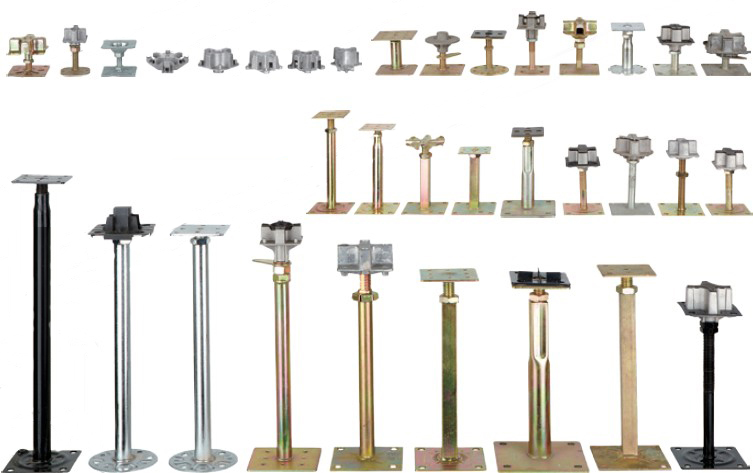
Rod-Type Pedestals: The Foundation for Steel Cementitious Floors
Rod-type pedestals represent the most straightforward design in the floor pedestal family. The construction centers on a vertical threaded rod that provides height adjustment capability. This rod connects a base plate at the bottom to a top head plate, creating a simple yet effective support structure.
Design Characteristics of Rod-Type Pedestals
The threaded rod allows continuous height adjustment throughout the pedestal's range. Installers rotate the head plate along the threaded rod to achieve precise floor leveling, typically with adjustment increments as small as 0.025 inches. This precision proves invaluable when working with uneven subfloors or when creating specific elevation transitions.
Rod-type pedestals come in two primary head configurations: cross-head and flat-head designs. Cross-head pedestals feature perpendicular positioning tabs that help align and stabilize floor panels during installation. Flat-head designs offer a simpler profile suitable for stringerless systems where panels rest directly on the pedestal heads.
Surface treatment typically involves galvanization to prevent corrosion. According to HUATENG's manufacturing standards, galvanizing comes in white or yellow zinc finishes, with each offering equivalent corrosion protection but different aesthetic appearances. The choice between colors often depends on customer preference or project specifications rather than performance differences.
Applications and Compatibility
Rod-type pedestals pair primarily with bare-finish steel cementitious floor panels. These panels feature exposed steel surfaces without additional coverings, making them cost-effective for environments where aesthetic considerations rank below functionality. Common applications include electrical rooms, mechanical spaces, and industrial facilities where the floor pedestal system supports equipment rather than providing finished occupied space.
The load capacity of rod-type pedestals depends on several factors including rod diameter, base plate size, and anchoring method. Standard rod-type designs typically support concentrated loads between 1,000 to 1,500 pounds, adequate for most office and light commercial applications. Testing according to CISCA standards verifies that pedestals can withstand specified loads without permanent deformation.
Tube-Type Pedestals: The Industry Standard for Versatile Applications
Tube-type floor pedestals have emerged as the most widely adopted design in modern raised flooring installations. The cylindrical or tubular construction provides inherent strength and stability that surpasses rod-type designs, making these pedestals suitable for demanding commercial and institutional environments.
Tube Construction Variations
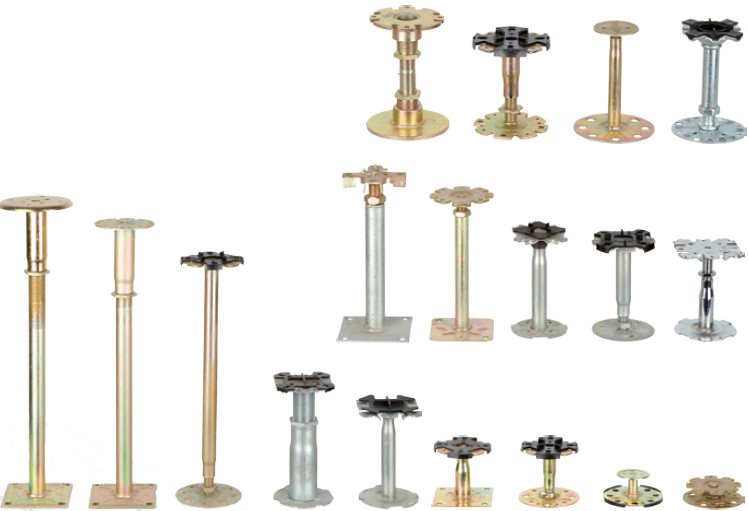
Three primary tube configurations dominate the market: round shrink tubes, round straight tubes, and square straight tubes. Each design offers specific advantages depending on application requirements.
Round shrink tube pedestals feature a tapered profile where the tube diameter decreases toward the top. This design provides exceptional stability because the lower portion of the tube offers maximum resistance against lateral forces and overturning moments. The shrink tube configuration represents the most popular choice for floor pedestal installations according to industry data, particularly in office buildings and data centers where stability under varying loads is paramount.
Round straight tube and square straight tube pedestals maintain uniform cross-sections throughout their length. This consistency offers a distinct advantage: installers can cut these tubes on-site to adjust for extensive height variations without requiring a complete pedestal replacement. This flexibility reduces inventory requirements and simplifies logistics for large projects with varying floor elevations.
Integration with Stringer Systems
HUATENG tube-type pedestals work seamlessly with stringer systems—horizontal support members that connect pedestal heads to create a rigid grid structure. Stringers provide several critical benefits: they distribute loads more evenly across multiple pedestals, create a more rigid floor system that resists deflection, and establish the below-floor space for organized cable routing and air distribution.
The stringer connection method varies by system design. Some systems use snap-on stringers that installers can attach and remove by hand without tools, enabling quick access to the underfloor space. Other designs employ bolt-on stringers secured with screws, providing greater rigidity for heavy-duty applications. The choice between methods depends on access frequency requirements and load specifications.
Head Configuration Options
Tube-type floor pedestals accommodate various head shapes to match different floor panel types. Round heads suit steel cement panels, while square heads work better with woodcore and calcium sulfate panels. The head design includes positioning features—tabs, grooves, or interlocking profiles—that prevent panel shifting once installed.
According to construction specifications documented in industry guides, pedestal heads typically measure 3.5 inches square, providing adequate support surface while maintaining compatibility with standard 24-inch floor panel grids.
| Tube Type | Stability | Field Adjustability | Best Application |
|---|---|---|---|
| Round Shrink Tube | Excellent | Limited | Standard office and data center installations |
| Round Straight Tube | Very Good | Excellent (can be cut) | Projects with variable height requirements |
| Square Straight Tube | Very Good | Excellent (can be cut) | Retrofit projects and mixed-height installations |
Heavy-Duty Pedestals: Engineered for Extreme Loads and Heights
Heavy-duty pedestals represent specialized floor pedestal designs engineered to handle exceptional loading conditions and elevated installation heights. While technically a subset of tube-type pedestals, their enhanced construction warrants separate consideration due to distinct application requirements.
Enhanced Structural Components
The key differentiator in heavy-duty designs lies in reinforced component dimensions. These pedestals feature thicker-gauge steel in both tubes and base plates compared to standard models. Base plates typically measure larger in surface area—often 6 inches square or greater versus the 4-inch standard—to distribute concentrated loads across more subfloor area and reduce point loading stress.
Tube wall thickness increases proportionally, with heavy-duty models using 14-gauge or 12-gauge steel compared to 16-gauge standard tubes. This thicker material resists buckling under axial loads and provides greater resistance to lateral forces that become more significant as floor heights increase.
Load Capacity Specifications
According to HUATENG's engineering specifications, heavy-duty floor pedestals support concentrated loads ranging from 1,500 to over 3,000 pounds per square foot. This capacity far exceeds standard pedestals and enables installations supporting dense equipment arrays, battery systems, or other infrastructure requiring exceptional floor strength.
Testing protocols verify this performance through axial load testing where pedestals must support specified weights without permanent deformation. The pedestal overturning moment—the resistance to tipping when lateral force is applied—also receives enhanced specifications for heavy-duty models, typically requiring resistance to moments of 2,000 inch-pounds versus 1,000 inch-pounds for standard designs.
Height Considerations
Heavy-duty pedestals become mandatory when floor heights exceed 600mm (approximately 24 inches). As elevation increases, the lever arm for lateral forces grows longer, magnifying overturning moments and buckling risks. The reinforced construction of heavy-duty pedestals counteracts these increased forces.
For installations requiring heights above 1,200mm (approximately 48 inches), additional structural considerations come into play beyond pedestal selection alone. Construction specifications typically require lateral bracing systems that connect pedestals to create a more rigid structure capable of resisting seismic forces and other horizontal loads.
Typical Applications
Data centers represent the primary application for heavy-duty floor pedestals. These facilities concentrate massive equipment weight in relatively small areas—racks of servers, storage arrays, networking equipment, and UPS systems can create point loads exceeding standard floor capacity. The floor pedestal system must reliably support this infrastructure while providing the deep underfloor plenum required for cooling air distribution.
Industrial clean rooms, semiconductor fabrication facilities, and pharmaceutical manufacturing spaces also commonly specify heavy-duty pedestals. These environments combine equipment loads with the need for significant underfloor space accommodating process piping, chemical distribution systems, and extensive electrical infrastructure.
Based on HUATENG's project experience, telecommunications facilities, network operations centers, and mission-critical control rooms also benefit from heavy-duty floor pedestal specifications even when current equipment loads might not require them. The enhanced capacity provides future-proofing, allowing facility upgrades without floor system replacement.
Critical Selection Factors for Floor Pedestals
Choosing the appropriate floor pedestal type requires evaluating multiple interconnected factors. Making the right selection ensures long-term system performance, safety, and cost-effectiveness.
Load Requirements Analysis
Start by determining the maximum concentrated loads and uniform distributed loads the floor will experience. Concentrated loads come from individual equipment items—server racks, filing cabinets, safes, or any heavy object occupying a small floor area. Uniform loads represent evenly distributed weight across the entire floor surface.
Calculate both current and anticipated future loads. Technology facilities should account for potential equipment density increases over the facility's lifetime, typically projected at 10 to 25 years. Adding 25 to 50 percent capacity margin above calculated loads provides safety factor and future flexibility.
Subfloor Condition Assessment
The subfloor's flatness, strength, and surface condition directly affect pedestal performance. Concrete slabs should meet flatness tolerances before pedestal installation—typically within 1/8 inch over 10 feet. Significant deviations require additional leveling compound application or selection of pedestals with greater adjustment range.
Concrete strength influences anchoring method selection. Weak or deteriorated concrete may not provide adequate holding power for adhesive-only installation, requiring mechanical fasteners or supplemental reinforcement. Conduct pull tests on the actual subfloor to verify adhesive bond strength meets specifications.
Finished Floor Height Determination
Required underfloor services volume dictates minimum floor height. Cable-only installations may function at heights as low as 80mm to 150mm. Adding underfloor HVAC distribution typically requires 300mm to 450mm. Complex facilities with extensive electrical, data, and mechanical infrastructure may need 600mm or more.
Height also impacts pedestal selection. As discussed previously, exceeding 600mm triggers heavy-duty pedestal requirements. Very low heights (under 100mm) may limit pedestal options, potentially requiring low-profile specialized designs.
Panel Compatibility Verification
Floor panels and pedestals must match both mechanically and structurally. Panel corner details—the method of attachment and support—must align with pedestal head design. Some systems use screwed connections, others employ gravity-held designs with positioning tabs.
Panel weight and material also influence pedestal selection. Lightweight woodcore panels impose less load on pedestals than dense calcium sulfate or concrete-filled panels. However, the panel's own structural capacity must match pedestal spacing—a strong pedestal supporting weak panels creates a system only as capable as its weakest component.
| Selection Factor | Key Considerations | Impact on Pedestal Choice |
|---|---|---|
| Load Capacity | Equipment weight, future expansion plans | Determines standard vs. heavy-duty requirement |
| Floor Height | Underfloor services volume, accessibility needs | Heights over 600mm require heavy-duty pedestals |
| Panel Type | Material, weight, attachment method | Head design must match panel corner detail |
| Subfloor Condition | Flatness, concrete strength, surface preparation | Affects anchoring method and adjustment range needed |
| Seismic Requirements | Building location, local codes | May require mechanical anchors and lateral bracing |
Installation Considerations and Best Practices
Proper installation determines whether floor pedestals perform to their design capacity throughout the system's service life. Even correctly specified pedestals fail when installation quality falls short.
Anchoring Methods
Floor pedestals attach to subfloors through adhesive bonding, mechanical fastening, or a combination of both methods. Adhesive-only installation uses epoxy resin-based compounds applied between the pedestal base plate and concrete slab. This method works well for standard loading conditions on sound concrete but requires proper surface preparation—cleaning, removing contaminants, and ensuring dry conditions.
Mechanical anchoring employs concrete fasteners—typically four per pedestal base plate—that bolt the pedestal to the slab. This method provides superior resistance to overturning forces and proves necessary in seismic zones or when subfloor concrete quality raises concerns about adhesive bond strength.
Combined installation uses both adhesive and mechanical fasteners, providing maximum security. High-performance environments such as data centers often specify this approach despite added labor costs because it eliminates single-point-of-failure risks.
Leveling Procedures
Achieving level floor surfaces requires systematic pedestal adjustment. Installers typically establish a reference elevation using laser levels or optical instruments, then adjust each pedestal to match this reference plane. The adjustment mechanism—threaded rods or locking nuts—enables fine-tuning measured in fractions of an inch.
According to HUATENG's installation guidelines, final floor levelness should not exceed 1/16 inch variation over 10 feet of floor surface. Tighter tolerances may be required for facilities housing sensitive equipment or where aesthetic concerns demand perfectly flat floors.
Quality Verification
Post-installation testing verifies that the floor pedestal system meets performance specifications. Testing methods documented in industry standards include pedestal pull tests to verify anchoring strength, floor deflection measurements under simulated loading, and comprehensive leveling surveys.
Specific attention focuses on perimeter conditions where floor pedestals meet walls or structural columns. These transition zones often require specialized support details to prevent differential settlement or gaps that compromise system integrity.
Maintenance and Long-Term Performance
Floor pedestal systems require minimal maintenance when properly installed, but periodic inspection ensures continued safe operation and identifies potential issues before they escalate.
Routine Inspection Points
Annual inspections should check for loose pedestal connections, signs of corrosion on exposed metal components, and floor panel movement that might indicate pedestal settlement or failure. In high-vibration environments—such as facilities with rotating equipment or high foot traffic—more frequent inspection intervals may be warranted.
Particular attention should focus on areas experiencing load changes. If equipment is added or relocated, verify that affected floor pedestals still provide adequate support. Overloading beyond design capacity can cause immediate failure or accelerate fatigue that leads to delayed collapse.
Common Issues and Solutions
Floor creep—gradual panel movement over time—typically results from inadequate pedestal anchoring or panel-to-pedestal connection. Addressing this requires removing affected panels, re-anchoring pedestals, and potentially upgrading connection hardware.
Squeaking or creaking noises when walking on the floor often indicate metal-to-metal contact between panels and pedestal heads. Installing or replacing sound-deadening gaskets between these surfaces usually resolves the issue without requiring major system intervention.
Localized floor deflection beyond acceptable limits suggests either inadequate pedestal support or failing pedestals. This condition requires immediate investigation because it indicates structural distress that could lead to sudden failure.
Need Expert Guidance on Floor Pedestal Selection?
Selecting the right floor pedestal system requires balancing technical requirements, budget constraints, and long-term performance goals. Whether you're planning a new data center, renovating an existing office, or upgrading industrial facilities, expert support ensures optimal results.
HUATENG brings over two decades of raised access floor manufacturing experience to every project. Our engineering team can evaluate your specific requirements and recommend the ideal floor pedestal configuration—from standard tube-type designs for office applications to heavy-duty systems for demanding data center environments.
Contact our technical team today to discuss your project requirements and receive customized floor pedestal recommendations.
Summary: Making the Right Floor Pedestal Choice
Understanding the three typical types of floor pedestals—rod-type, tube-type, and heavy-duty designs—enables informed decision-making for raised access flooring projects. Each type serves specific applications where its characteristics provide optimal performance and value.
Rod-type pedestals offer simplicity and cost-effectiveness for basic applications with steel cementitious panels. Tube-type pedestals provide the versatility, strength, and compatibility that make them the industry standard across diverse commercial and institutional settings. Heavy-duty pedestals deliver the enhanced capacity essential for data centers, industrial facilities, and any application involving exceptional loads or elevated floor heights.
Successful pedestal selection requires evaluating load requirements, floor height needs, panel compatibility, and installation conditions. Working with experienced manufacturers ensures that these factors receive proper consideration and that the resulting floor pedestal system delivers reliable long-term performance.
The choice of floor pedestal type fundamentally shapes your raised flooring system's capability, durability, and suitability for intended use. Investing time in proper specification during the planning phase prevents costly modifications and ensures your facility's infrastructure foundation performs as intended throughout its service life.
Frequently Asked Questions
What is the typical height range for floor pedestals?
Floor pedestals typically range from 80mm to 2000mm in height. Low-profile applications use 80-150mm pedestals for cable management, while data centers often require 300-600mm for airflow distribution. Heights exceeding 600mm require heavy-duty pedestal designs.
How do I determine which pedestal type my project needs?
Consider four factors: expected floor loads, required height, panel type compatibility, and installation conditions. Office spaces typically use standard tube-type pedestals, while data centers with equipment loads exceeding 1,500 pounds per square foot require heavy-duty designs. Consult with manufacturers for project-specific recommendations.
What is the difference between stringered and stringerless pedestal systems?
Stringered systems use horizontal steel members connecting pedestal heads, creating a rigid grid that distributes loads across multiple supports. Stringerless systems support panels directly on pedestal heads without horizontal members. Stringered systems provide greater load capacity and rigidity but require more complex installation.
Are floor pedestals adjustable after installation?
Yes, most floor pedestals feature height adjustment mechanisms allowing post-installation leveling. Standard designs typically offer 1-2 inches of adjustment range through threaded rods and locking nuts. However, major height changes after adhesive has cured may require pedestal replacement rather than simple adjustment.
How are floor pedestals anchored to the subfloor?
Three methods exist: adhesive bonding using epoxy resin compounds, mechanical fastening with concrete anchors, or combined installation using both. Standard applications often use adhesive-only installation, while seismic zones or heavy-duty applications require mechanical or combined anchoring for enhanced security.
What load capacity should I specify for data center floor pedestals?
Data center floor pedestals should support concentrated loads of 1,500 to 3,000 pounds per square foot depending on equipment density. Modern high-density server deployments typically require heavy-duty pedestals rated for at least 2,000 pounds per square foot with appropriate safety factors for future equipment additions.
Can existing floor pedestals be reused in renovation projects?
Reusing floor pedestals is possible if they remain in good condition, meet current load requirements, and are compatible with new panels. However, factors like corrosion, damage during removal, and changes in height requirements often make replacement more cost-effective than attempting reuse.
How often should floor pedestals be inspected?
Annual inspections suffice for most installations. Check for loose connections, corrosion, panel movement, and signs of overloading. High-vibration environments or facilities with frequent equipment changes may require semi-annual or quarterly inspections to ensure continued safe operation.
About HUATENG
Changzhou Huateng Access Floor Co., Ltd. is a leading manufacturer specializing in raised access flooring solutions with over 20 years of industry experience. Our comprehensive product line includes OA raised access floors, anti-static raised access floors, calcium sulphate raised access floors, aluminum raised access floors, and a complete range of floor pedestals and accessories.
Certified under both ISO 9001 and ISO 14001 management systems, HUATENG access floors serve diverse applications including offices, computer rooms, data centers, clean rooms, and public facilities worldwide. Our engineering team provides technical consultation, custom design services, and comprehensive project support to ensure optimal floor pedestal selection and system performance.
When seeking a reliable supplier for your raised access flooring project, HUATENG delivers proven quality, technical expertise, and responsive service backed by two decades of manufacturing excellence. Contact us to discuss how our floor pedestal solutions can meet your specific project requirements.
Get Your Custom Floor Pedestal Solution
Ready to discuss your raised access flooring project? Our technical team is here to help you select the perfect floor pedestal system for your application.
WhatsApp: +86 13775027302 | Email: info@huatengaccessfloor.com
 CopyRight © 2026 - Changzhou Huateng Access Floor Co., LTDAll rights reserved