




How to Build a Raised Floor Over a Concrete Slab? A Professional Guide
In data centers, modern offices, cleanrooms, or industrial environments requiring flexible cabling and efficient ventilation, raised floor systems have become indispensable infrastructure. Constructing such floors directly over concrete slabs can effectively utilize space, conceal pipelines, and enhance environmental adaptability. However, to ensure the system is stable, level, and durable, following correct construction steps is crucial. This article details how to build a raised floor over a concrete slab step by step to help you successfully complete your project.

Thorough Planning & Preparation
Assess the Concrete Slab
Flatness Inspection: Use a straightedge or laser level to check the concrete slab's flatness. Severe unevenness (typically requiring a tolerance within ±3mm/m) must be leveled first (e.g., with self-leveling cement); otherwise, it will affect the stability and flatness of the raised floor.
Strength & Dryness: Ensure the concrete slab has reached sufficient strength (usually above C25) and is fully dry (moisture content meets the floor system's requirements) to avoid later deformation or damage.
Cleanliness: Thoroughly remove dust, oil, debris, and other contaminants from the concrete surface to ensure adhesives (if needed) or pedestals can adhere firmly.
Define Requirements & Design
Load-Bearing Needs: Determine the weight of equipment (e.g., server racks, heavy furniture) and human activity loads the floor must support. This is the core basis for selecting the strength of floor panels and the support system.
Height Requirements: Calculate the required under-floor space height (typically 150mm–1000mm+) based on the quantity and diameter of cables (power, data) and pipes to be installed.
Panel Type Selection: Choose based on the application scenario:
Standard panels: For general use.
High-load panels: Such as calcium sulphate raised floors, preferred for heavy-load areas like data centers due to their high strength, fire resistance, excellent flatness, and environmental friendliness.
Ventilated panels: Such as perforated metal flooring, used in areas requiring under-floor air conditioning (e.g., machine rooms, cleanrooms), with perforation rates selected according to air volume needs.
Installing the Pedestal Support System
Layout & Marking
Based on the design drawings, accurately snap grid lines on the floor to determine the center position of each pedestal base. Grid sizes are typically 600x600mm or 610x610mm, with denser spacing at edges and heavy-load areas.
Optional Vapor Barrier
If the concrete slab is at risk of moisture (e.g., basement levels), lay a moisture-proof film to protect the under-floor space.
Install Pedestal Bases
Use specialized adhesives (e.g., epoxy glue) or mechanical fasteners (e.g., expansion bolts) to securely fix the pedestal bases at the marked points on the concrete slab. Ensure the top of each base is level.
Set Pedestal Height
Install adjustable pedestal heads or screw rods on the bases. Use a laser level and ruler to precisely adjust the height of each pedestal head to the design elevation, forming a horizontal reference plane. This is a critical step to ensure the final floor’s flatness.
Install Stringers (Optional but Recommended)
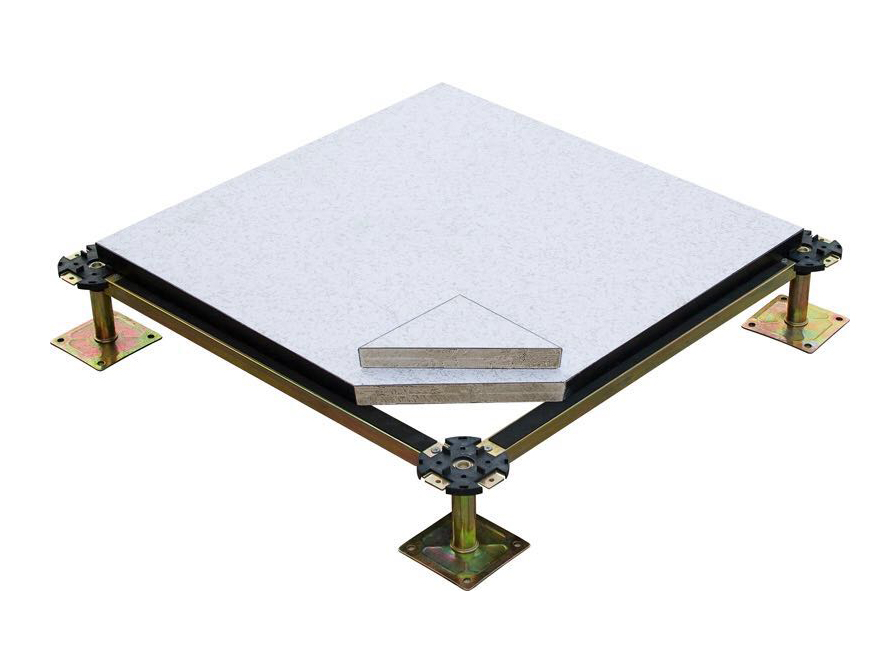
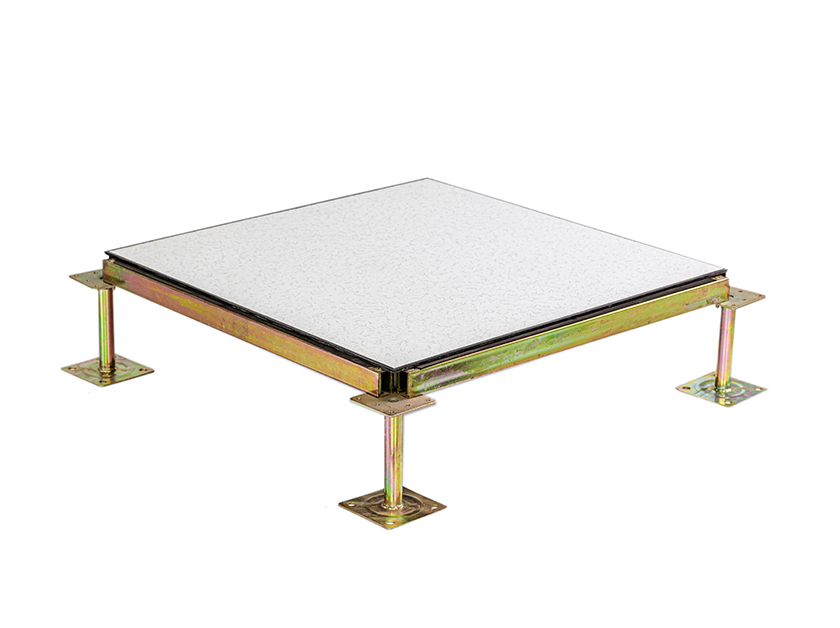
Install stringers (horizontal crossbars) between rows of pedestal heads and secure them with bolts or clips. Stringers form a rigid grid, significantly enhancing the stability and load uniformity of the entire floor system—especially important when using panels like calcium sulphate raised floors.
Laying the Raised Floor Panels
Starting Point
Begin laying from a corner of the room (e.g., a right angle near the main entrance) or a central reference point to ensure alignment and seam consistency.
Panel Placement & Leveling
Carefully place the first raised floor panel onto the tops of four pedestals (or the stringer grid). Use a rubber mallet to tap and adjust the position, and check flatness with a spirit level. Fine-tune pedestal heights if necessary.
Sequential Laying & Cutting
Lay adjacent panels in sequence, ensuring tight and aligned seams. Use specialized cutting tools (e.g., power saws) to precisely cut edge and corner panels to fit irregular areas or bypass columns. When cutting calcium sulphate raised floors, pay attention to dust control; when cutting perforated metal flooring, deburr the edges.
Special Panel Installation
Install perforated metal flooring or other functional panels (e.g., cable access openings) at planned locations, ensuring they are flush with surrounding standard panels.
Finishing & Final Inspection
Cleaning & Protection
Remove all debris and dust generated during installation, especially from panel surfaces and the under-floor space.
If panel surfaces have protective films, remove them after cleaning. Before subsequent renovations or equipment installation, consider laying temporary protective layers (e.g., cardboard or padding).
Edge Trims & Ramps
Install baseboards, edge trims, or ramps to cover gaps between the floor edges and walls, providing an aesthetic transition and preventing foreign objects from entering the under-floor space.
Comprehensive Inspection
Flatness Check: Recheck the entire floor surface with a straightedge or level.
Stability Check: Conduct a walking test to ensure no abnormal 晃动 (shaking) or noise, and that all panels are securely supported.
Movable Component Check: Test that all openable perforated metal flooring or access panels operate smoothly.
Choose a Professional Partner for Exceptional Raised Floors
The key to successfully building a raised floor system over a concrete slab lies in precise planning, high-quality components, standardized installation processes, and strict acceptance standards. Whether you need the extreme load-bearing and fire-resistant properties of calcium sulphate raised floors or the heat-dissipating perforated metal flooring for precision environments, correct selection and construction are the foundation for long-term stable system operation.
As an experienced professional raised floor supplier, HUATENG understands the core needs of various applications. We not only provide a full range of high-quality raised floor system components (including high-performance calcium sulphate panels, precisely adjustable support systems, and diverse ventilated panels) but also offer strong technical support and project guidance. HUATENG’s products strictly adhere to industry standards, focusing on details and durability to ensure your floor system is safe, stable, flat, beautiful, and long-lasting.
If you are planning to build a raised floor system over a concrete base, HUATENG is your trusted partner. We provide comprehensive services from design, product selection to installation guidance, helping you create efficient, flexible, and reliable under-floor space solutions. Contact the HUATENG team today for professional consulting and customized solutions!
 CopyRight © 2026 - Changzhou Huateng Access Floor Co., LTDAll rights reserved