




Which Raised Access Flooring System Is Right for You in 2025
Choosing the right raised access flooring system in 2025 depends on project goals. Steel panels work best for heavy loads and high durability, while stringerless systems suit spaces needing frequent layout changes. Low profile access floor systems excel at cable management access floor solutions, especially in smart offices and data centers. Key factors include cost, stability, load capacity, flexibility, installation, maintenance, and application. Industry trends highlight the importance of technological advancements, environmental standards, and design flexibility. Many offices select hpl raised floor or oa floor for efficient cable management access floor needs and easy integration with automation systems.
Key Takeaways
Choose a raised access flooring system based on your space’s needs like load capacity, flexibility, and budget.
Stringer systems offer the best stability and support for heavy equipment, ideal for data centers and industrial areas.
Stringerless and low profile systems install faster and provide flexibility, making them perfect for offices with frequent layout changes.
Select panel materials carefully to balance durability, fire resistance, and cost; steel and calcium sulphate are strong options.
Regular maintenance and proper installation extend floor life, improve safety, and reduce long-term costs.
Types of Raised Access Flooring Systems
Stringer Systems
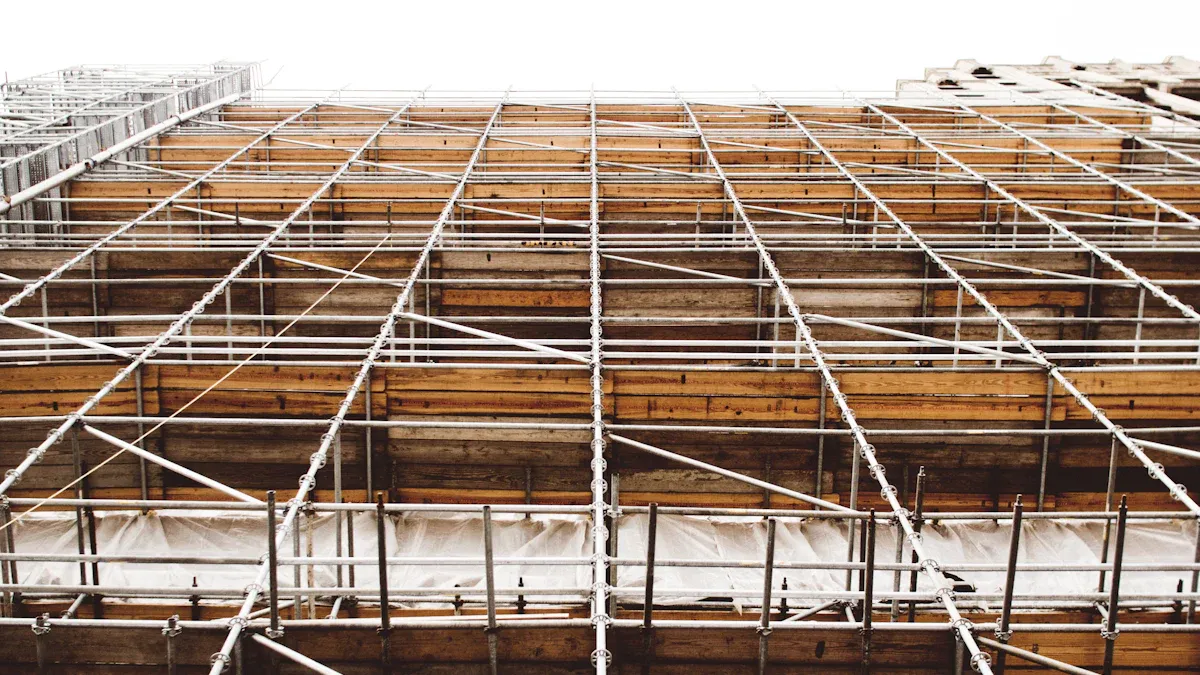
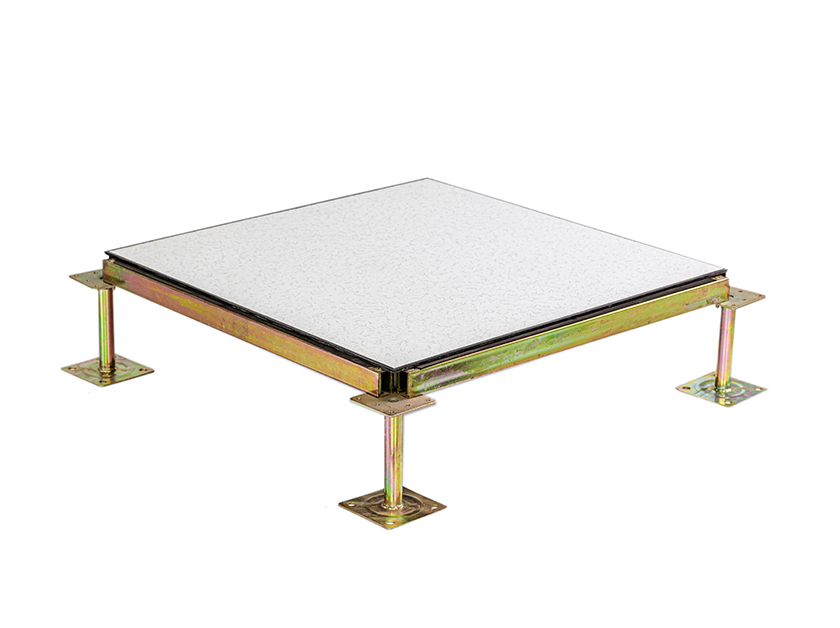
Stringer access floors use horizontal steel or aluminum bars, called stringers, that connect pedestal heads. These bars create a grid that supports the panels and increases the floor’s stability. Stringer access floors provide high load capacity and keep panels aligned. They also reduce vibration and noise, making them ideal for environments with heavy equipment or strict environmental controls. Data centers, server rooms, and areas with sensitive electronics often use this type of access floor system. The installation process takes more time and costs more because of the extra materials and complexity. However, stringer access floors offer better sealing and contamination control than other systems.
Tip: Stringer access floors work best in spaces where stability and load support matter most.
Stringerless Systems
Stringerless access floors do not use horizontal bars between pedestals. This design makes installation faster and less expensive. Stringerless access floors allow for easy reconfiguration and quick access to the underfloor area. They suit offices and spaces that need frequent layout changes. However, these systems provide less stability and lower load capacity than stringer access floors. They may not align panels as consistently and can allow more noise and vibration. Stringerless access floors fit best in flexible workspaces and areas with lighter equipment.
Low Profile Systems
Low profile access floor systems have a shallow height, usually between 1.58 and 2.76 inches. These systems help manage cables and wiring in offices with limited ceiling height. Low profile access floor supports organized cable routing, reduces tripping hazards, and protects wires from damage. Many corporate offices, data centers, and educational spaces choose low profile access floor for its quick installation and easy maintenance. These systems also meet ADA requirements by providing level, slip-resistant surfaces and smooth transitions.
Low profile access floor systems improve energy efficiency by supporting underfloor air distribution.
They blend with existing decor and allow for future technology upgrades.
Panel Materials
Raised access floors use several types of panel materials, each with unique benefits:
Steel & Concrete: These panels offer high strength and durability. They suit data centers, control rooms, and equipment rooms that need a traditional access floor with superior load support.
Calcium Sulphate: This material resists fire and sound, making it eco-friendly and safe. Offices and computer rooms often use calcium sulphate panels for their anti-static and soundproof qualities.
Woodcore: Woodcore panels use high-density particle board with steel cladding. They provide a cost-effective solution for offices, libraries, and control rooms. Hpl raised floor and oa floor often use woodcore panels for easy cable management.
Aluminum: Lightweight and corrosion-resistant, aluminum panels work well in labs and cleanrooms. They handle sensitive equipment and resist magnetic interference.
Concrete-core: These panels combine steel and concrete for maximum load capacity. Heavy-duty environments and data centers rely on concrete-core panels for a traditional access floor system.
Note: Choosing the right panel material ensures the access floor system meets the space’s needs for durability, safety, and flexibility.
Key Features Comparison
Load Capacity
Load capacity stands as one of the most important factors when selecting an access floor system. Different systems and panel materials offer varying strengths:
Stringered pedestals provide increased load capacity, enhanced stability, and improved structural integrity. They work best for heavy equipment and high-traffic areas.
Stringerless pedestals offer easier installation and lower material costs but have less load capacity and stability. They suit light office use.
Low-profile pedestals are lightweight and easy to install. They have lower load capacity and limited space for underfloor systems.
The following table compares typical load capacities and applications:
| Flooring System Type | Typical Application Areas | Load Capacity / Ratings (lbs) | Key Characteristics and Suitability |
| Bolted Stringer System | Data centers, server rooms, heavy load areas | Highest lateral support; designed for heavy rolling loads and seismic loading | Outstanding stability and high load capacity; ideal for heavy equipment and industrial environments |
| Stringerless Corner Lock System | Offices, casinos, lower load environments | Lower lateral support compared to stringer systems | Adaptable and easy to install; suitable for lighter loads and dynamic office spaces |
| Low-Profile Pedestals | Low-clearance environments (offices, retail) | Lower load capacity | Lightweight, easy to install; limited space for underfloor systems; suitable for retrofits and limited floor height |
| Stringerless Pedestals | Light office use, areas prioritizing ventilation | Lower load capacity and stability | Simplifies installation and reduces material costs; less stable in high-traffic areas |
| Stringered Pedestals | Data centers, control rooms, high-traffic areas | Increased load capacity and stability | Includes horizontal stringers for enhanced structural integrity; suitable for heavy equipment and constant movement |
| Calcium Sulphate Panels | High and low load applications (data centers, offices) | Ultimate load rating: 3400 | Environmentally friendly, fireproof, waterproof, rigid, durable |
| Wood Core Panels | Low load and foot traffic applications | Static: 1,000–1,500; Ultimate: 2,400–4,000 | Durable, fire rated, good acoustic performance |
| Aluminum Panels | High-tech environments (labs, clean rooms) | Ultimate load: 4,000 per 24"x24" panel | Lightweight, non-magnetic, easy to handle; good rolling load capacity |
| Hollow Steel Panels | High-traffic areas | Static: 1,250; Ultimate: 5,000 | Strong, fireproof, durable; interchangeable with cementitious systems |
| Concrete Panels | IT applications, heavy load areas | Static load capacity up to 2,500 | Long product life, stable floor, good wire management and air distribution |
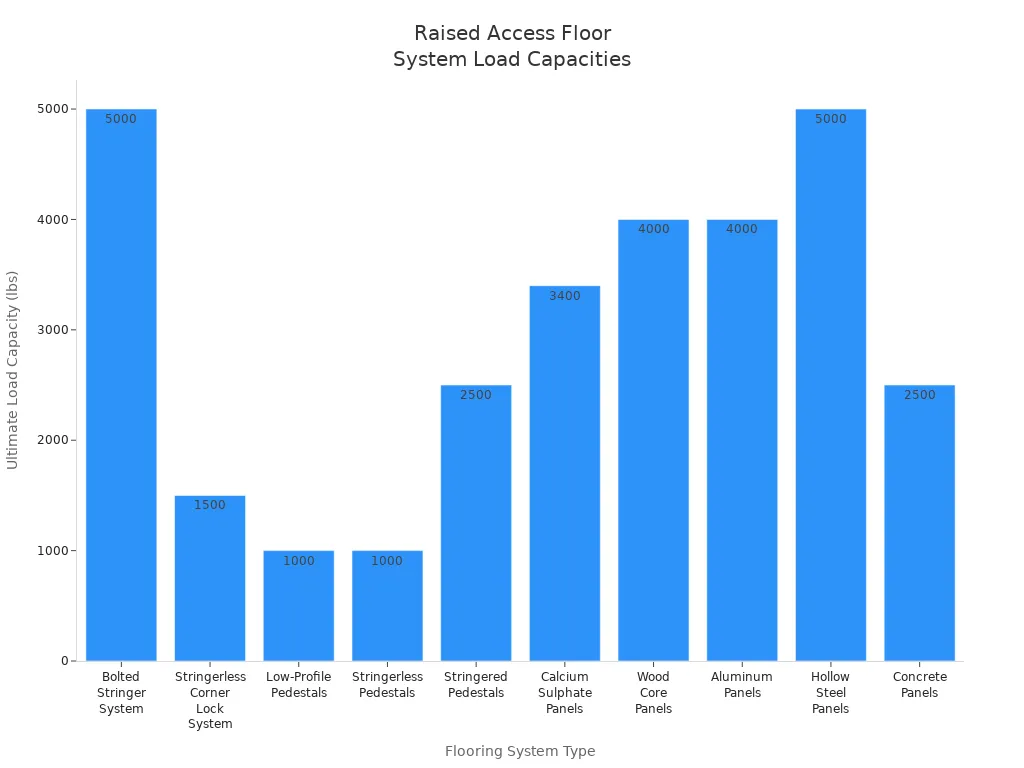
Stringer access floors, especially those with bolted stringers, deliver the highest load ratings. These systems support heavy rolling loads and resist seismic forces. Stringerless and low-profile systems work best for lighter loads and flexible office spaces.
Stability
Stability ensures the floor feels solid underfoot and supports equipment safely. Stringer access floors use horizontal bars to connect pedestals, which increases lateral support and reduces vibration. This design keeps panels aligned and prevents movement, even in high-traffic or equipment-heavy areas.
Stringerless systems, while easier to install, offer less stability. They may allow more panel movement and vibration, especially in busy spaces. Low-profile systems, due to their shallow height, provide less structural support and work best in areas with minimal equipment.
Tip: For environments with heavy equipment or constant movement, stringer access floors provide the most reliable stability.
Flexibility
Flexibility matters most in spaces that change often, such as modern offices or tech environments. Raised access flooring systems use modular panels that can be removed and replaced easily. This design allows quick access to cables, wiring, and HVAC systems beneath the floor.
Raised access floors allow easy removal of individual panels for quick access to underlying services, supporting repairs, upgrades, and reconfigurations.
The modular design enables fast changes to office layouts, data centers, and retail spaces without major renovations.
Adjustable pedestals and customizable materials, such as hpl raised floor and oa floor, support future upgrades and evolving technology needs.
This adaptability saves time and money, making the access floor system a smart choice for businesses that expect growth or frequent changes.
Installation
Installation speed and cost depend on the type of access floor system. Stringerless systems install faster because they use fewer components. Low-profile systems also offer quick installation, especially in retrofit projects or spaces with limited floor height.
Stringer access floors require more time and labor due to the extra stringers and alignment steps. However, they provide better long-term performance in demanding environments.
The table below shows typical labor costs for different systems:
| Raised Access Flooring System Type | Labor Cost Range (per sq. ft.) |
| Office Raised Floor System | $3 - $6 |
| Data Center Raised Floor System | $5 - $10 |
| Server Room Raised Floor System | $3 - $5 |
Labor costs for data center installations can reach $12 to $15 per square foot in some markets, reflecting higher complexity and stricter requirements.
Maintenance
Proper maintenance extends the life of any access floor system. Most systems require regular inspections, cleaning, and occasional repairs.
Daily cleaning with microfiber mops keeps surfaces dust-free.
Monthly checks of pedestal tightness and grounding connections prevent structural issues.
Annual replacement of damaged panels (5–10% over 10 years) maintains floor integrity.
Tasks may include leveling, tightening panels, replacing floor grills, managing cable entries, and resurfacing panels.
Subfloor sealing and fire prevention measures protect against dust and hazards.
Maintenance costs vary by material and region. Steel panels offer a lower-cost option, while calcium sulfate and aluminum panels cost more but provide added benefits like fire resistance and lightweight handling.
| Material Type | Cost Range (per m²) | Notes |
| Steel panels | $300–500 | Lower cost option |
| Calcium sulfate panels | $600–900 | Mid-range cost |
| Aluminum panels | $800–1,200 | Higher cost, lightweight |
| Labor Costs | Cost Range (per m²) | Region |
| U.S./Europe | $30–50 | Higher labor cost regions |
| Asia | $15–25 | Lower labor cost regions |
Cost
Cost includes both initial investment and long-term expenses. Stringerless and low-profile systems usually cost less to install due to fewer materials and faster setup. Stringer access floors cost more upfront but provide better durability and stability, which can reduce repair and replacement costs over time.
Panel material also affects price. Steel panels offer a budget-friendly choice for many offices. Calcium sulfate and aluminum panels cost more but deliver extra features like fire resistance and lightweight handling. Hpl raised floor and oa floor options provide efficient cable management and easy integration with modern office technology.
Note: Choosing the right access floor system balances cost, performance, and future needs. Investing in quality materials and proper installation pays off with fewer repairs and longer service life.
Raised Access Floors: Quick Comparison Table
Choosing the right system for raised access floors depends on several factors. The table below compares the most common systems and panel materials. It highlights important features like load capacity, cost, flexibility, installation, maintenance, and best use cases.
| System / Panel Type | Load Capacity (lbs) | Weight per Panel (lbs) | Cost ($/m²) | Flexibility | Installation | Maintenance | Best Use Cases |
| Stringer System (Steel) | 1250 | 23 | 300–500 | Moderate | Moderate | Low | Data centers, heavy equipment |
| Stringerless System | 1000 | 28 (woodcore) | 300–500 | High | Fast | Low | Offices, flexible layouts |
| Low Profile System | 1000 | 28 (woodcore) | 300–500 | High | Fast | Low | Smart offices, cable management |
| Concrete Filled Steel Panel | 1000–1500 | 36 | 400–600 | Moderate | Moderate | Moderate | Control rooms, IT environments |
| Calcium Sulphate Panel | N/A | 39 | 600–900 | Moderate | Moderate | Moderate | Computer rooms, eco-friendly |
| Aluminum Panel | 1000–1250 | 32 | 800–1200 | High | Fast | Low | Labs, cleanrooms |
| Woodcore Panel | ~1000 | 28 | 300–500 | High | Fast | Low | Offices, hpl raised floor, oa floor |
Tip: Stringer systems with steel panels offer the highest stability and load support. Stringerless and low profile systems provide more flexibility and faster installation, making them ideal for modern offices and spaces that use hpl raised floor or oa floor for cable management.
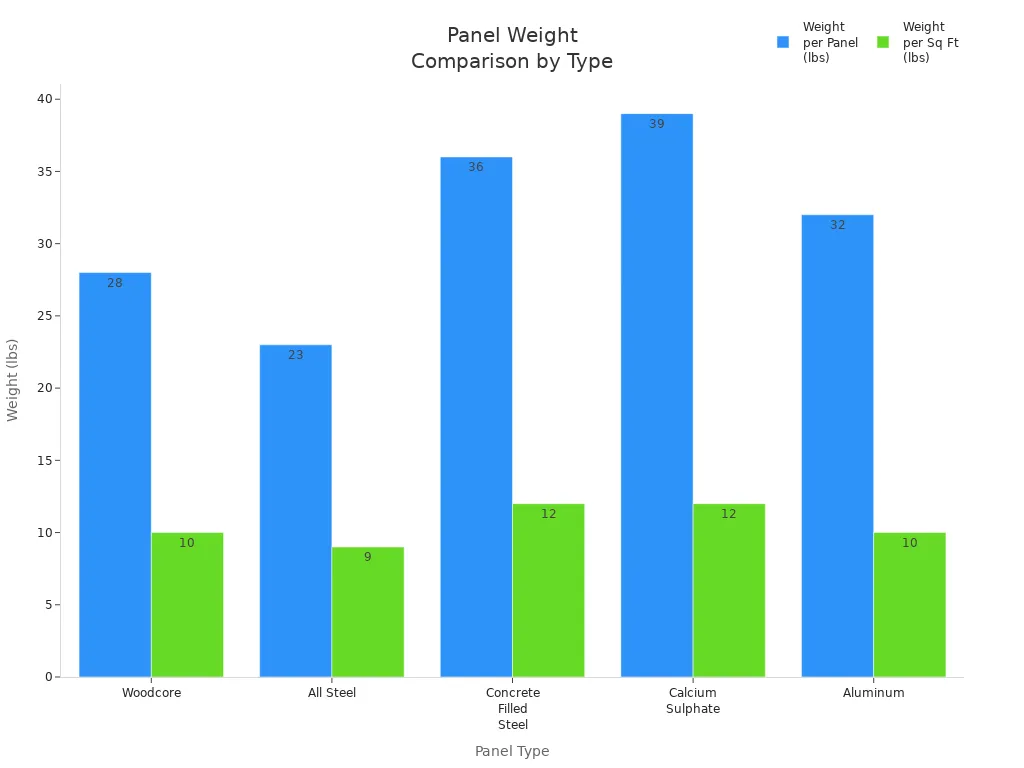
Concrete filled steel panels use welded steel plates and a cement core. This design gives high strength and fire resistance. These panels spread weight evenly, which helps in areas with heavy equipment. Woodcore panels weigh less and work well in offices that need easy access and quick changes. Aluminum panels are light and resist corrosion, making them a good choice for labs and cleanrooms. Calcium sulphate panels are heavier and provide good fire and sound resistance.
Raised access floors give users many options. Each system fits different needs, from heavy-duty data centers to flexible office spaces.
Decision Guide
Budget
Selecting the right access floor system starts with understanding the budget. Project managers often look for ways to balance cost with performance. Several factors influence the total cost:
Load Capacity and Floor Strength: Choose panels and pedestals that match the weight of equipment. This prevents damage and avoids early replacement.
Material Selection: Steel-clad particleboard and cement core panels offer different price points. Durable finishes like hpl raised floor or oa floor can increase initial costs but lower long-term expenses.
Room Layout and Cabinet Arrangement: Placing cabinets parallel to floor tiles helps distribute weight and improves airflow. This setup can reduce energy bills.
Airflow Management: Perforated tiles in cold aisles and hot/cold aisle containment improve cooling efficiency. Lower energy use means lower costs.
Maintenance and Longevity: Regular inspections and cleaning extend the floor’s life, sometimes up to 20 years. This reduces the need for expensive replacements.
Installation Quality: A level subfloor and well-adjusted pedestals prevent structural issues that can raise costs.
Energy Efficiency: Good design can cut cooling costs, which impacts the overall budget.
Tip:Structural integrity matters. Poor installation or damaged panels can lead to costly repairs or equipment damage.
Panel materials and finishes also affect both initial and maintenance budgets. Adjustable pedestal heights allow customization, which can optimize both cost and performance.
Load Needs
Every space has unique load requirements. Data centers, industrial spaces, and offices all need different levels of support. The table below shows common panel types and their load capacities:
| Panel Type | Recommended Use | Concentrated Load Capacity (lbs) |
| Steel-encapsulated | Most robust panel option | Up to 1,250 |
| Woodcore | Wood composite core with steel/aluminum facing | Up to 1,000 |
| Concrete-filled steel | Steel base with concrete infill | 1,000 to 1,500 |
| Aluminium | Lightweight panel option | 1,000 to 1,250 |
| Floor Grade | Area of Use | Load Capacity Description |
| Standard | Office spaces, light data centers | Supports moderate loads, up to ~950-1,250 lbs per panel |
| Enhanced | Data centers, server rooms | Supports higher loads and moderate rolling loads |
| Heavy Duty | Industrial, large data centers | Very high load capacity, up to 1,500 lbs concentrated load |
| Seismic-Grade | Earthquake-prone areas | High load capacity with seismic resistance |
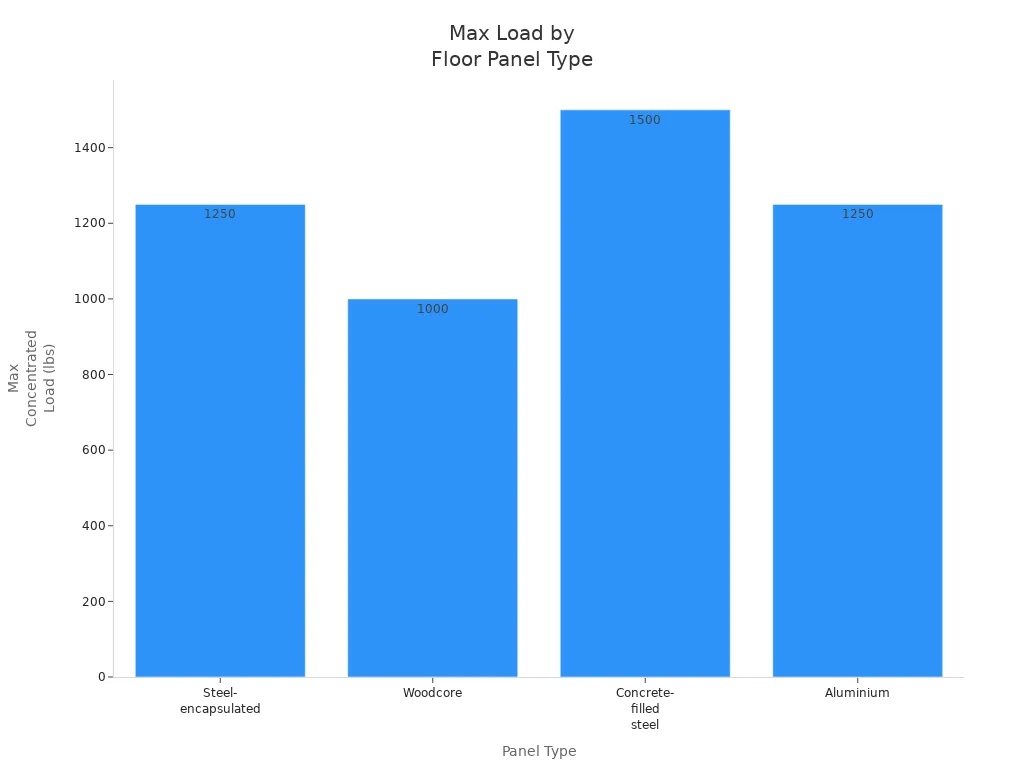
Raised access flooring systems for high load environments can support up to 1,500 lbs per square foot. Rolling loads, such as moving equipment, may reach up to 3,750 lbs per square foot with proper safety factors. Choosing the right system ensures the floor can handle heavy equipment and frequent movement without failure.
Flexibility
Modern offices and tech spaces often change layouts. Flexibility in an access floor system supports these changes. Raised access flooring allows easy access to electrical and data cabling. This makes quick reconfiguration possible as needs change.
Raised access flooring provides a hidden space for cables, HVAC, and plumbing. This supports fast changes without major renovations.
The system enables efficient use of space and rapid changes in infrastructure.
Customization options, such as hpl raised floor and oa floor, allow offices to match both function and style.
Improved HVAC distribution supports adaptable environmental control.
Raised access flooring enhances flexibility, adaptability, and future-proofing for dynamic office environments.
Code Compliance
Building codes and safety standards guide the selection of an access floor system. Compliance ensures the floor meets fire safety, load ratings, and accessibility requirements.
Fire resistance: Materials like calcium sulphate and steel panels offer high fire ratings.
Accessibility: Low profile access floor systems help meet ADA requirements by providing level, slip-resistant surfaces.
Seismic resistance: Seismic-grade systems protect equipment and people in earthquake-prone areas.
Project managers should review local codes before choosing a system. This step prevents costly changes during or after installation.
Maintenance
Maintenance affects both the lifespan and cost of an access floor system. Durable materials, such as steel or robust composites, reduce the need for repairs. Regular inspections and cleaning keep the floor safe and functional.
Daily cleaning with microfiber mops removes dust.
Monthly checks of pedestal tightness and grounding connections prevent problems.
Annual replacement of damaged panels maintains integrity.
Subfloor sealing and fire prevention measures protect against hazards.
Materials with higher durability, like steel, lower the frequency of repairs and replacements. This reduces environmental impact and supports sustainability goals.
Aesthetics
Aesthetics play a key role in offices, retail, and public spaces. Raised access flooring panels come in many finishes, including carpet, vinyl, laminate, stone, polished wood, and industrial-grade carpet tiles.
Porcelain and ceramic tiles offer durability and resist wear. These finishes suit high-traffic areas but may increase upfront costs.
Wood flooring provides an elegant look and can be cost-effective, but it needs more maintenance and is sensitive to moisture.
Sound-absorbing finishes, such as acoustic vinyl or cushioned carpet tiles, improve noise reduction.
Eco-friendly options, like bamboo or recycled vinyl, support sustainability.
Modular panels made from steel, aluminum, or woodcore support high loads and offer design variety.
The choice of finish affects both durability and maintenance. Offices can match their interior design themes while ensuring the floor meets performance needs.
Applications
Data Centers
Data centers require strong, stable floors that support heavy servers and manage airflow. The best choice is a stringer system with steel or concrete-filled panels. These panels handle high concentrated loads and resist vibration. Most data centers use static dissipative high pressure laminate surfaces to protect electronics from static. Perforated airflow panels help direct cool air to equipment, which keeps servers from overheating. Coordination between IT and mechanical teams ensures the floor supports both equipment and cooling needs. Many data centers select hpl raised floor panels for their durability and static control.
| Feature | Description | Importance for Data Centers |
| Floor Covering | Static dissipative high pressure laminate | Protects electronics from static; easy to clean |
| Airflow Management | Perforated panels with various open areas | Delivers cool air efficiently to servers |
| Cooling Optimization | High-density airflow panels | Supports complex cooling needs |
Offices
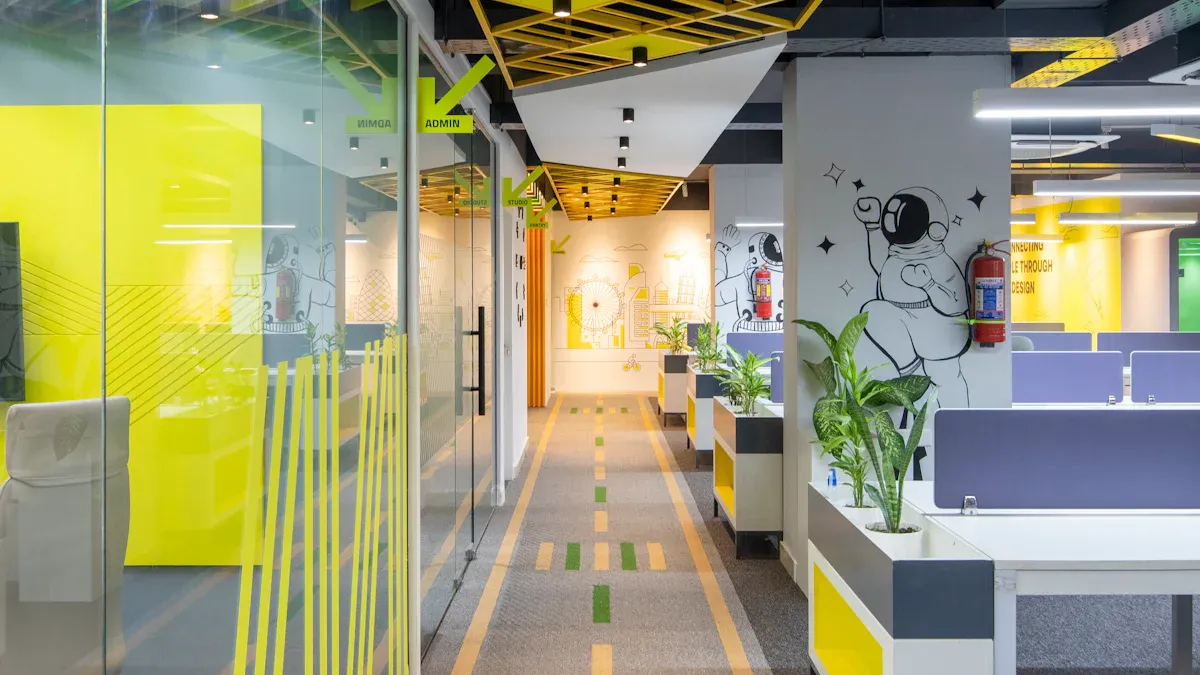
Modern offices need flexible layouts and easy cable management. Low profile access floor systems work best here. These systems use modular panels on pedestals, creating a shallow space for cables. Workers can move desks or equipment without major changes. The panels come in many finishes, such as carpet or wood, to match office decor. hpl raised floor and oa floor panels are popular for their neat cable organization and quick access for repairs. This system helps offices stay organized and ready for future upgrades.
Low profile systems support open-plan offices, meeting rooms, and executive suites.
Modular design allows fast changes and easy maintenance.
Industrial Spaces
Industrial spaces often use heavy equipment and need floors with high load capacity. Concrete or hollow steel panel systems provide the best support. These panels resist water, fire, and heavy impacts. Calcium sulfate panels work well in areas with moisture or temperature changes. For spaces needing sound control, wood core panels offer good acoustic performance. Aluminum panels suit high-tech or clean industrial areas. The modular design allows for easy replacement of damaged panels, which is important in busy environments.
| Flooring System Type | Suitability for Heavy Equipment | Key Durability Features |
| Concrete | Excellent | High load, water/fire resistant |
| Hollow Steel | Very Good | Durable, customizable finishes |
| Calcium Sulfate | Good | Moisture and corrosion resistant |
| Wood Core | Moderate | Acoustic control, less for heavy loads |
| Aluminum | Specialized | Antimicrobial, easy to clean |
Specialized Environments
Cleanrooms and laboratories have strict requirements for cleanliness and environmental control. Raised access flooring system designs for these spaces use seamless, non-porous materials like epoxy, vinyl, or polyurethane. These floors resist chemicals and prevent contamination. Underfloor spaces allow for hidden wiring and controlled airflow. Tate Access Flooring Systems are often chosen for their quality and ability to support eco-friendly building goals. These systems help maintain air quality and adapt to changing equipment needs.
Note: Specialized environments benefit from flooring that supports both cleanliness and flexibility. Seamless finishes and modular panels make cleaning and upgrades simple.
Common Mistakes
Selecting and installing a raised access flooring system involves many steps. Mistakes during these steps can lead to safety hazards, higher costs, and reduced performance. Many users overlook important details when working with a traditional access floor, hpl raised floor, or oa floor system. The following list highlights the most frequent errors:
Improper handling of panels often causes damage. Dragging or lifting panels without suction lifters can misalign the floor and create instability.
Uneven weight distribution places heavy equipment away from load-bearing points. This mistake risks structural failure and uneven surfaces.
Ignoring environmental controls leads to problems. Humidity outside the 40-55% range or temperatures beyond 18-25°C can warp panels, cause corrosion, or increase static.
Using the wrong adhesives or underlayments results in poor adhesion. This can make maintenance difficult and allow moisture to cause mold.
Skipping regular inspections allows loose or damaged panels to go unnoticed. Quarterly or bi-annual checks help prevent safety risks and extend the floor’s lifespan.
Poor underfloor maintenance lets dust and moisture build up. This can reduce equipment efficiency, cause corrosion, and create fire or tripping hazards.
Failing to secure pedestals and stringers properly leads to misaligned panels and safety issues.
Lack of staff training on proper use and care increases accidental damage and shortens the life of the traditional access floor.
Regular maintenance, correct installation, and proper training help prevent these issues. Following manufacturer guidelines and using suitable materials ensures the raised access flooring system performs safely and efficiently.
Selecting the right raised access flooring system depends on the space and its needs. Data centers and server rooms benefit from steel or hpl raised floor panels with perforated designs for airflow. Offices often choose oa floor or low profile systems for flexible layouts and cable management. Key industry findings include:
Raised access flooring improves cable organization, cooling, and safety.
Modular panels support easy upgrades and smart technology integration.
These systems reduce downtime and lower maintenance costs.
| Application Scenario | Core Requirements | Recommended Floor Types and Features |
| Data Centers, Server Rooms | High load, heat dissipation, anti-static | Steel or hpl raised floor with perforated panels for airflow |
| High-end Offices | Aesthetics, flexibility | hpl raised floor supporting modular layouts and rapid adjustments |
Readers should review their project’s needs before choosing a system. For tailored advice, consulting a professional raised floor manufacturer like HUATENG ensures the best fit for any environment.
FAQ
What is the main difference between hpl raised floor and oa floor?
hpl raised floor uses high-pressure laminate for surface durability and static control. oa floor focuses on cable management and flexibility in office layouts. Both systems support modern office needs but serve different priorities.
How often should users inspect a raised access flooring system?
Experts recommend checking the system every three to six months. Regular inspections help spot loose panels, damaged pedestals, or cable issues early. This routine keeps the floor safe and extends its lifespan.
Can hpl raised floor panels handle heavy equipment?
Yes. hpl raised floor panels offer strong load capacity. They support heavy office equipment and server racks. Always check the manufacturer’s load rating before installation.
Is oa floor suitable for smart office upgrades?
oa floor works well for smart offices. It allows quick changes to cable layouts and supports new technology. Many companies choose oa floor for its easy access and future-proof design.

 CopyRight © 2026 - Changzhou Huateng Access Floor Co., LTDAll rights reserved